

I grew up in a religion that had a very clean understanding of personal responsibility.
You were taught what was right. You chose the right or the wrong. And what you chose reflected what was in your heart. If ye love me, keep my commandments. Obedience was evidence of what was going on under the surface. Follow-through was faithfulness. And if you fell short, the answer was always to pray harder, try harder, and want it more. Have faith to be changed.
I didn’t realize how bone deep that theory went until I left and it went along with me. I might not believe the devil is making me sin anymore, but I still believed this:
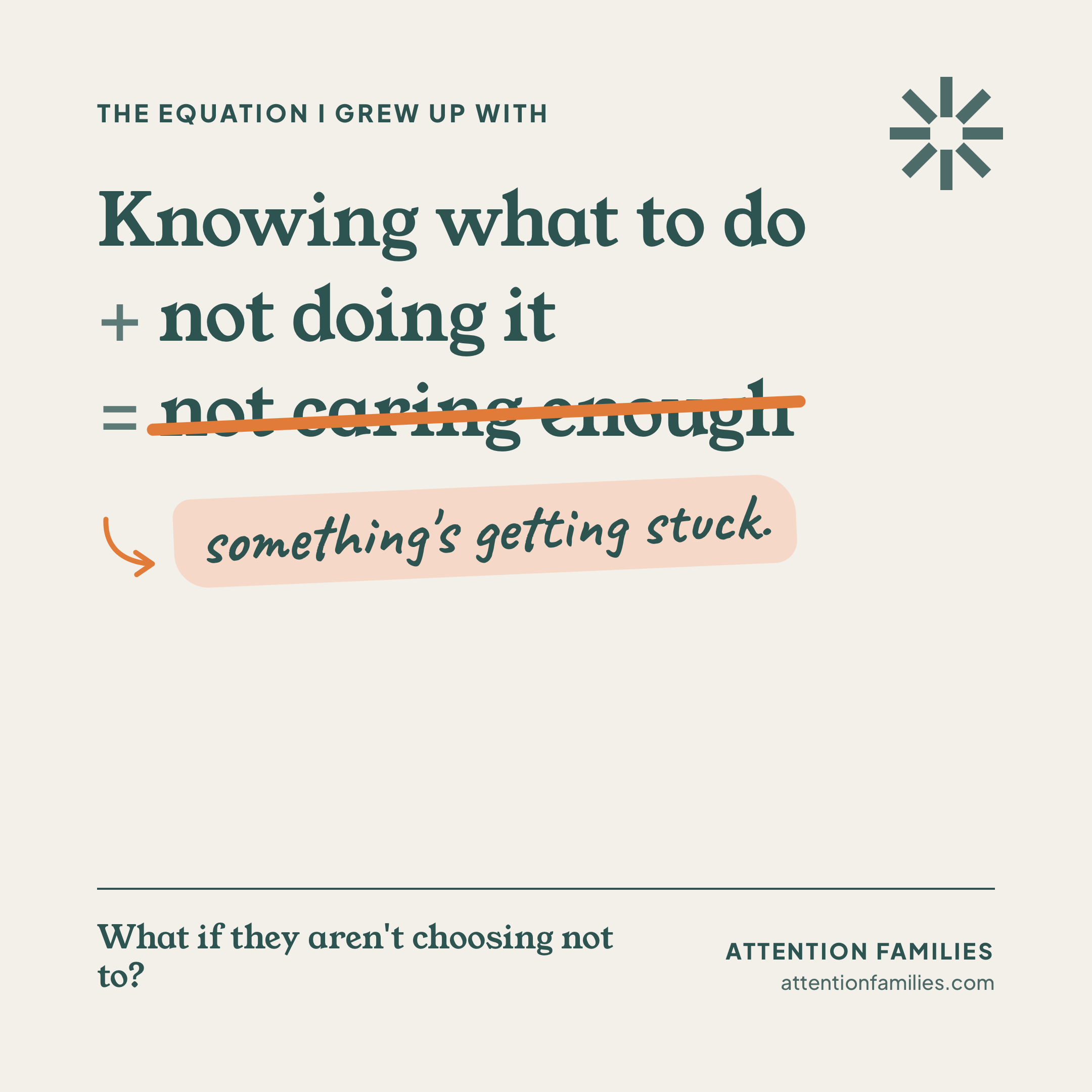
Knowing what to do + not doing it = not caring enough.
I am STILL dismantling this nonsense. As an ADHD coach, I’ve learned that most of the families I work with are living by it too. Many of them have never been near a church. They aren’t living by any religious tenets. But they’re still living by that BS equation.
So I want to ask a question:
What if someone truly wants to do the thing, knows how, understands why it matters, and still can’t make it happen reliably?
Has that ever happened to you? Or to your kid?
They’re not refusing. They’re not indifferent. Knowing and doing simply run on different machinery. And for ADHD brains, the connection between the two is often where things break down.

The laundry isn’t about the laundry
Picture a basket of clean clothes in the hallway.
Your kid has been asked to put it away. They know where everything goes. They could explain it to you. If anyone asked, they’d agree it’s their job.
An hour or even a day later, the basket is still there. So you remind them. Then you remind them again. By the third reminder your voice is tight. Louder. And you hear yourself saying things you swore you were going to stop saying:
Why do I have to keep telling you?
You know how to do this.
You obviously just don’t care.
Now the conversation is about respect, effort, and what kind of person your child is. It’s about character.
And nobody has figured out why the laundry is still in the hallway. Why your child hasn’t managed to put it away.
Maybe once the basket was out of sight, the task disappeared from their mind completely. Maybe starting is the challenge, and the task itself would take four effortless minutes. Maybe they were deep in something else and couldn’t shift gears. Each of those is a different problem with a different fix.
None of them gets solved by telling a child, again and again, that laundry is their responsibility. They already know that. Knowing is NOT the problem.
Where the gap gets filled
The work I do as a coach is mostly in that space between what someone knows and what they can consistently do.
That space is uncomfortable. So we rush to fill it with explanations. Lazy. Unmotivated. Irresponsible. Not trying. We use those words on our kids. And we use them on ourselves.
The problem is that they don’t actually explain anything. They sound like answers, but they actually end the conversation. Once you’ve decided someone is lazy, there’s nothing left to look into. They just need to stop. To be someone else.
Think about a kid who can do the homework. They understand the material and could finish any single assignment tonight. But they aren’t facing one assignment. They’re facing fifteen missing ones, all overdue, all equally urgent, all piled into one huge daunting mass.
At that point the problem isn’t the schoolwork. It’s not math or history. It’s knowing where to start when everything feels impossible at once.
A lecture about responsibility won’t teach that. A consequence may even make the pile feel more threatening, which makes starting even harder. What helps is sitting down together and finding one doable first step, and then, over time, teaching them how to work through that overwhelm on their own.
That gives them something new. A way forward. Steps.
None of this means dropping expectations. It means we stop assuming the expectation will produce the ability to meet it.

Getting curious instead of furious
When I work with parents, I often start with a small assignment. Pick one thing your child knows how to do but struggles to do consistently. Just one. The problem that keeps coming back no matter how many things you’ve tried.
Then we stop asking why won’t they do it? and start asking what happens between intending to do it and actually doing it?
Does the task get forgotten once it’s out of sight?
Is getting started the hard part?
Are there more steps than they can hold in their head?
Is something in the environment making it harder?
Do they stall the moment something doesn’t go as planned?
You don’t have to guess. You can watch, ask, and then try a small change. If the change doesn’t work, that’s useful too. Because now you’ve ruled something out.
That feels very different from failing the same test of character every night. For you and for them.
Something to help you start
If you’re parenting a child with ADHD, you probably already have a situation in mind. Chores, homework, getting out the door, keeping an agreement you both made.
You’ve explained. You’ve reminded. You’ve tried patience and you’ve tried being firm. And you’re tired. Profoundly tired.
I made a free resource for exactly this: Why Isn’t This Working? The ADHD Quick Check. It walks you through taking one stuck situation and investigating what’s really getting in the way, before you reach for another reminder, consequence, or new system.
👉 Get the free ADHD Quick Check
You don’t need to understand your child’s entire brain. You don’t need to excuse their behavior. And you don’t need to give up on raising a capable, responsible, independent adult.
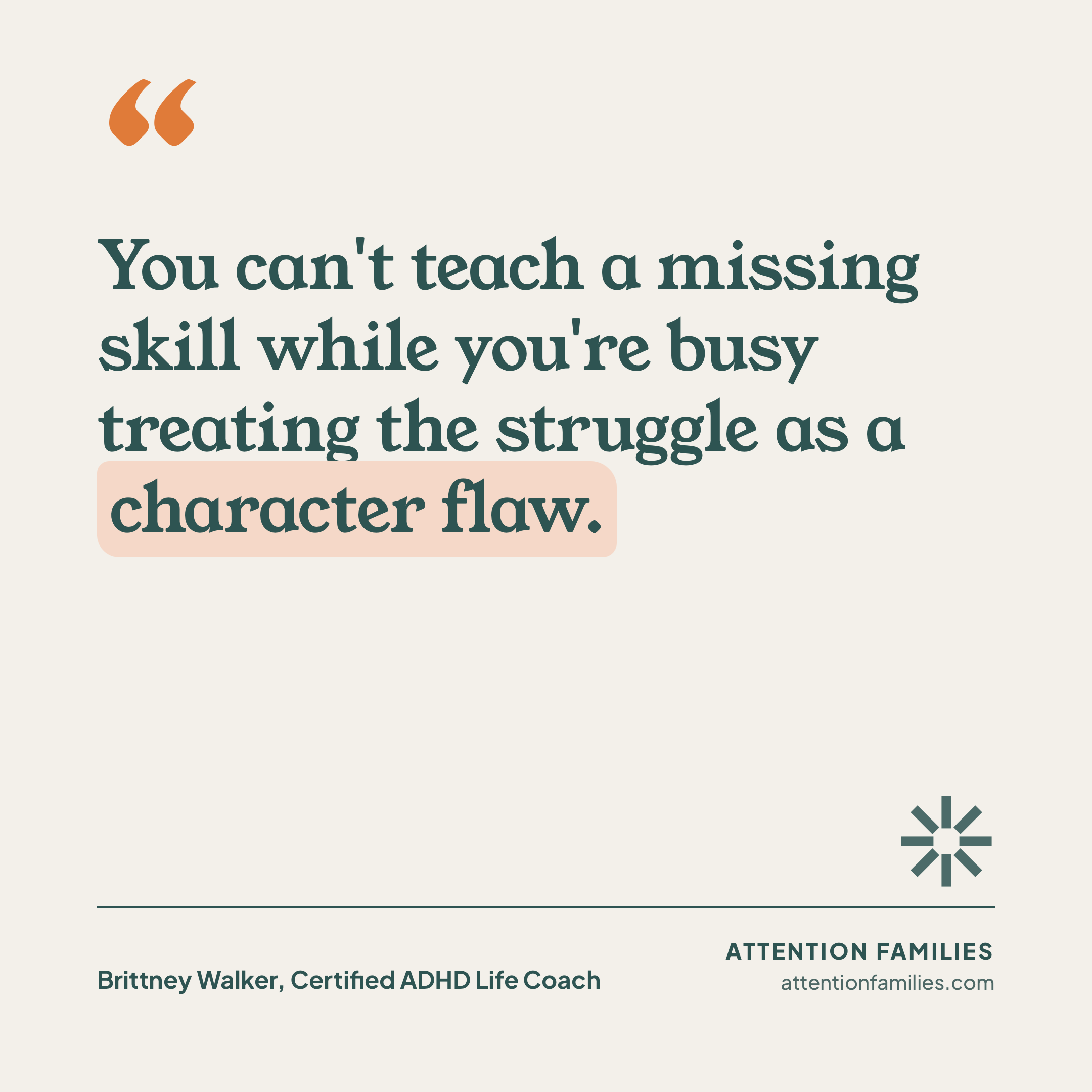
But you can’t teach a missing skill while you’re busy treating the struggle as a character flaw.
That’s true for our kids. Speaking as someone who spent a lot of years thinking her own struggles were proof of weakness, I think it’s true for many of us, too.
So the next time something isn’t getting done, try a different first question.
Not What’s wrong with you?
But Where is this getting stuck?
That question has an answer. And the answer is something you can actually work with.
I’m a Certified ADHD Life Coach and the founder of Attention Families. I help parents, teens, and adults figure out why the things they know how to do aren’t always the things they can make happen, and what to do about it.
This is so well said! Lightbulbs. I’ve been dabbling with micro systems this year as my oldest is in first grade. We figured out the impossible homework dilemma by dropping her off at her dads classroom for half an hour every Tuesday. Her homework packet gets done speedy quick because the location and consistency work for her. Last year she wouldn’t do homework for anything. No character flaw, just taking off the pressure and finding the right routine.